Showing posts with label Sabbath. Show all posts

Sunday, August 16, 2015

Sabbath Menuha

When I left my position as youth director at the Church of the Good Samaritan, almost five years ago, I planned to take three months of “Sabbath” while discerning what might come next.

It’s interesting how much discussion that simple word, “Sabbath,” sparked.

What is it? How do you do it?

I was trained to stay busy. I can sleep late- but rarely. I can hang in the hammock – if I’m reading something useful, planning something in my head, or taking a short break from the gardening at hand.

Three months of Sabbath?

The time went quickly, helped along by Dan B. Allender’s book named, simply. Sabbath. What I enjoyed about Allender’s approach was his idea that Sabbath is a way to reset the defaults inside us, reorient our vision, and find our place again in the larger plan.

I had always thought of Sabbath as partly about rules, and partly about rest.  Both, I confess, bore me. And who would want three months of either?

Allender suggests that the key to Sabbath is joy. Puzzling over God’s “rest” on the seventh day described in Genesis 2, Allender suggests “it should be obvious that God rests not because he was weary from his labor.” As Isaiah reminds us, “The Lord is the everlasting God, the creator of the ends of the earth. He will not grow tired or weary.”

Seems kind of obvious. But that suggests we’ve misunderstood some key point in the rationale for Sabbath. According to Allender:
Menuha is the Hebrew word for rest, but it is better translated as joyous repose, tranquility, or delight.  God didn’t rest in the sense of taking a nap or chilling out; instead, God celebrated and delighted in his creation.
Allender explores this theme of celebration and delight, our uneasiness with the idea that God desires our joy, and our preference for forging ahead on our own rather than pause long enough to see what wonders God has in mind.

The central section of Allender’s book considers “Sabbath purpose” as seen through the avenue of
play. I honestly don’t remember, ever, hearing play discussed in the context of the Christian faith.

Five years ago I was grieving the loss of play as I stepped out of active youth ministry. I have never lost my love of play – Capture the Flag in the woods, Boggle around a ski lodge table, impromptu games imvented by teens in pajamas at a Girls’ Night lock-in.

One of the tragedies of American adulthood – even childhood! - is that play is so narrowly permitted. In fact, think about it: for American women past a certain age, what kind of play, if any, is allowed? Youth ministry gave me space to stand on my head, reenact “Three Chartreuse Buzzards,” practice my offense in foosball, trash talk the opposition during our legendary games of Golden Fleece.

Allender reminds his readers of the incredible value play offers as a way to step outside of what is and see what might be, just as a small child might try on a Superman cape to explore a very different persona. He quotes Jürgen Moltmann, a theologian who explores “the interplay of creation, liberation, future, and play”:
We enjoy freedom when we anticipate by playing what can and shall be different and when in the process we break the bonds of the immutable status quo . . . the significance of games is identical with that of the arts, namely to construct ‘anti-environments’ and ‘counter-environments’ to ordinary and everyday human environments and through the conscious confrontation of these to open up creative freedom and future alternatives. We are no longer playing merely with the past in order to escape it for a while, but we are increasingly playing with the future in order to get to know it. (Theology of Play)
I remember playing paintball several years ago with a middle school boy who was used to being discounted. Both he and I, I’m sad to say, had been considered extraneous by our highly-competitive team. Our captain had a strategy that didn’t include either of us, and feeling a little left out, we planned our own simple maneuver. To the surprise of both teams, my normally timid accomplice captured the flag and delivered it to the other team’s pole while I provided strategy and cover and shouted wild encouragement. It was just a game, yet the alternative environment, our freedom to act, our escape of our predetermined roles, shifted things in every direction.

Allender says, “Play redistributes power and gives the opportunity for convention to be reconfigured by the unexpected and the inconceivable.” This is true in games of every kind, but Allender is on to something bigger: What would it mean to play with God? It sounds faintly heretical. Does God play?

In a spiritual direction session a number of years ago, I mentioned some difficulties and challenges I was facing. I was invited to spend some time in silence, picturing those challenges and inviting God to show me his presence in the midst of them. I imagined a long, mountainous path, strewn with heavy boulders. The terrain ahead seemed so daunting I couldn’t imagine moving forward. Then, as I invited God to show me his presence, I had a clear sense of Jesus himself, running lightly over the tops of the boulders. He motioned to me to follow and I stood, unable to move, conscious of my own poor balance, my serious fear of heights.

“What would you like to do?” he called. “Shall we dance across? Should I carry you over? Or . . . ” I remember the unexpected sense of glee I heard – and felt - in his voice, “shall we heave them all out of the way? Like this?” In my imagination I saw him tossing the boulders that troubled me, flinging them like Frisbees, bouncing them like weightless balloons.

I caught a glimpse of delight and play in that moment of meditation. My own approach to problems had always been much heavier. Yet, as I've seen so often since, to God every challenge is an occasion for him to show his grace, his strength, his goodness, an “opportunity for convention to be reconfigured by the unexpected and the inconceivable.” A chance to break through my narrow view with his greater, more joyful reality.

The path leading up to that time of Sabbath felt a bit like the imagined path littered by boulders. In every direction lay uncertainty, challenge, difficulty, even dread. In the years since, I’ve experienced a sense of being lighter on my feet, less fearful of the heights around me, in many ways, more playful.

I’ve been drawn more deeply into new possibilities, unimagined opportunities, reconfiguring of the status quo in my own life and in structures far larger. I take time each day to listen, to enjoy “menuha”: respose, tranquility, delight. And I work hard in ways I can only describe as all-out, unexpected fun.  

This summer my husband, Whitney, has found himself in his own three month sabbatical. Unlike mine, his will end with a reinvestment in the ministry he’s been part of for the past eighteen years. But for both of us it’s been a time of learning to hold even more lightly, to trust more deeply, to explore more fully Jesus’ invitation in Matthew 11: 29:
Take my yoke upon you and learn from me, for I am gentle and humble in heart, and you will find rest for your souls. For my yoke is easy and my burden is light.
Menuha!


[This summer I'm reworking some earlier posts, as travel and time outside limit my time for blogging. This blog appeared, in slightly different form, on July 31, 2011]


Please join the conversation. Your thoughts and experiences in this are welcome. Look for the "__ comments" link below to leave your comments. 

Sunday, July 10, 2011

Kensington Sabbath

July 2010

  1.  Fifteen feet by ten
  Two-thirds cement, still roses
  Bloom, and sparrows sing.

  2.  I will be rich and
  I will live – someplace – very
  Very far from here.

  3.  Teeth lost, back sagging
  Eyes slide away to distant
  Sadness – seventeen.

  4.  God breathes, a breeze stirs
  Cool air from the river, sweet
  Whispers of blessing.

  5.  Justice is the ache
  This lingering limp, this . . .
  Silence echoing.
     
For the past eleven summers I led a program called Urban Serve, a week-long children’s outreach in Kensington, a diverse neighborhood in Philadelphia with a high concentration of children living below the poverty level. The team I led was composed of teens and adults from my own suburban church and the partner church in Kensington. Each summer about two dozen of us gathered in the parish house of the Free Church of St. John, sleeping on the floor, and showering in the narrow yard behind the parish house, preparing a program to share the good news of Christ with neighborhood children, toddlers to teens as well as older siblings and parents.

The first year I was part of this program, we followed the model of our suburban church vacation Bible school. It was one of the most difficult weeks of my life. We worked hard, but few children came. I slept about ten hours the entire week, and somehow encountered the only poison ivy in Kensington in one of our small service projects. I promised myself I would never do the program again unless God showed us another way to do it.

July 2004
He did. The next summer we used outreach materials from Scripture Union, moved the program outside, and ran it in the early evening, when the streets around the church were full of wandering children. We registered more than a hundred children, gave away dozens of Bibles, and caught a clearer vision of how God intended to use the one week of outreach to energize ministry to children throughout the year.

It feels odd to be at home this morning, knowing the team is waking up from their first night on the floor, preparing to attend the morning service at St. Johns, getting ready to practice songs and dramas for the start of the children’s program this evening.

Looking back on my weeks in Kensington, I find that God used that time as an intensive annual graduate course in ministry. Trust, patience, obedience, endurance, wisdom, grace, courage, hope, compassion were all on the syllabus, along with intensive exposure to poverty, community, addiction, mental illness, injustice, systemic failure, amazing resilience.
July 2006

Every summer I approached our mission week with a sense of unease. I never felt ready, never felt like I had quite enough of whatever the week seemed to require. Our team was always weak in one way or another: not enough experienced leaders, not enough kids from the community, not enough musicians, not enough something. Yet, as I wrote last week, God’s supply is always enough: "And God is able to provide you with every blessing in abundance, so that by always having enough of everything, you may share abundantly in every good work.” 2 Corinthians 9:8.

Last summer I found myself mentally, spiritually, physically exhausted. It had been a very hard year of ministry, for a long list of reasons. There had been less support than usual, and far more challenges, and I felt in need of a month or two of sabbatical rather than a week of little sleep and hands-on leadership from dawn to well-past dark.

At the time, I was reading Sabbath, by Dan Allender, thinking and praying about how much I needed more Sabbath in my life. Just days before our mission, I was recording some highlights of the book in my journal when I had a strange thought: could the week in Kensington be a Sabbath?

“The Sabbath is the day in which we receive and extend the Father’s invitation to be reconciled.” (106). In a community divided racially, in a place where resentments simmer into physical violence, reconciliation is a message met with disbelieve and amusement. Even our team struggled with reconciliation. It’s never easy working and living side-by-side with people of different ages, different personalities, different cultural expectations about cleanliness, noise, time, personal space.  

Allender goes on to explain that part of Sabbath “is allowing the ‘not yet’ to be more real than the ‘is.’ . . . The Sabbath asks, how would you live if there were no wars, enmity,  battle lines, or need to defend, explain, interpret, or influence another to see anything differently? The Sabbath glories in the goodness, the amazing, solicitous, heart-thrilling glory of each person to whom we are privileged to speak .. .The Sabbath is the day we set aside to look at one another from the vantage point of eternity and then to operate in time, in an actual hour or minute, as if it is true.” (111)
July 2010

I wrote in my journal “Lord, I would like to approach Urban Serve as a Sabbath, a holy time set apart, a time of wonder, of play, of delight, of reconciliation.”

I had no idea what that would look like, but found, as the week unfolded that I saw our team differently, with much greater appreciation, much deeper awareness of what a gift each one was. The inevitable challenges took less mental energy. Iin fact, most became opportunities for creativity, good conversation, new levels of engagement. It wasn’t a perfect week, but in many ways, it was a much easier week. I was more fully aware of God’s presence, more conscious that we were working together as citizens of an eternal kingdom, at odds with, yet joyfully invading, the broken kingdom around us.

Sleep is often an issue for me, especially when I’m sleeping on the hard floor surrounded by two dozen people I’m responsible for. I hear every street noise, kids talking in their sleep, team members snoring. I wake at every footstep, every voice down the alley. We normally scheduled an hour of rest and reflection after lunch; for me that time was essential for mentally debriefing the hours before, planning needed changes to the hours ahead, then trying to regroup from the lack of sleep and constant noise.

July 2010
In Sabbath mode last summer, an odd thing happened. I slept more soundly, plans were resolved more quickly, my energy level was higher, and I found myself spending my rest and reflection time sitting in various corners, praying and writing poetry. I hadn’t written poetry in over two decades, but for some reason, sitting in the “not yet” of the coming kingdom, things looked different, and poetry seemed a good way to respond.

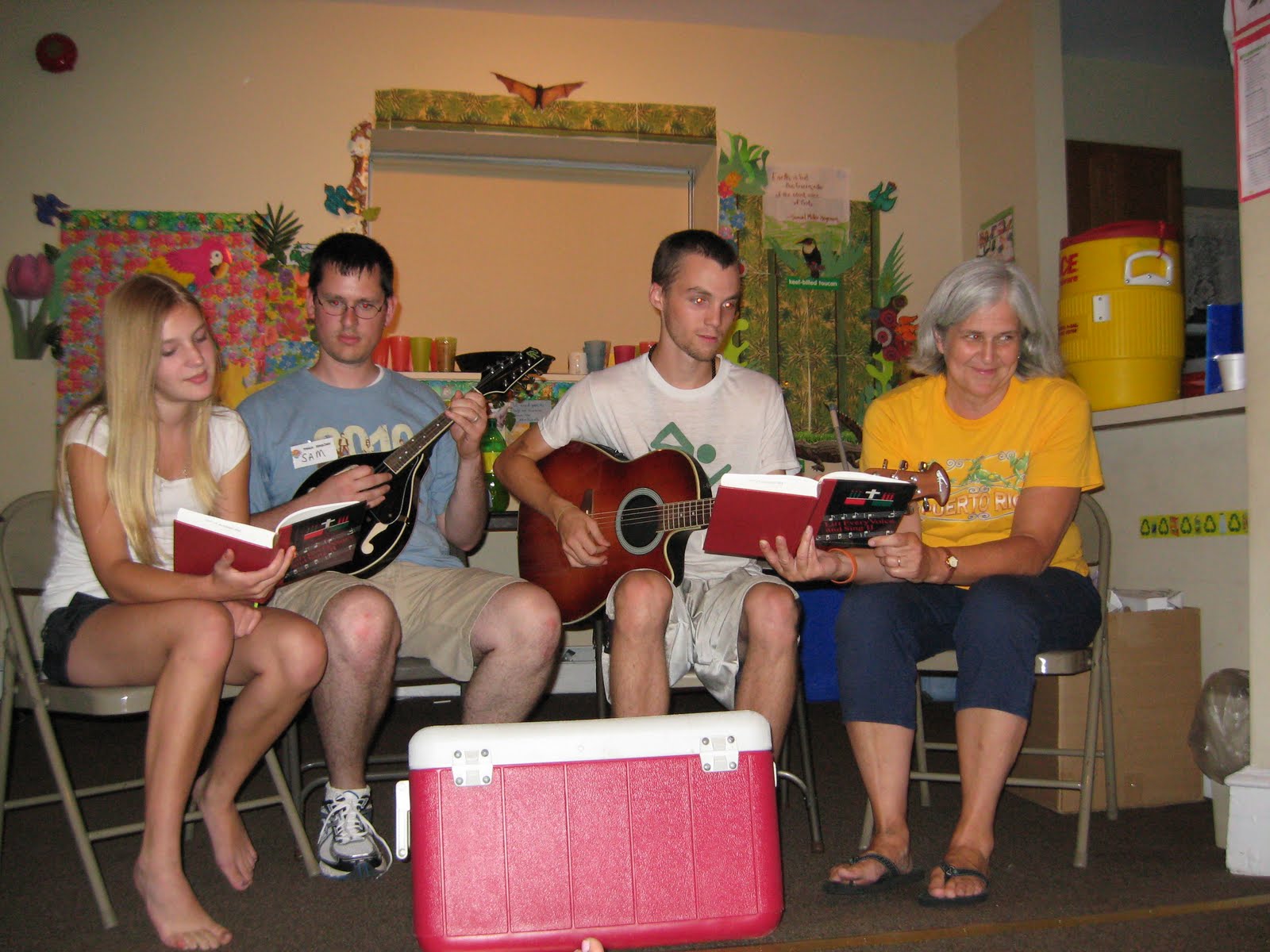
We also found more time to sing - worship in the church yard before the program, worship with the team late into the evenings, some gospel bluegrass for fun at odd moments of the day, with "The Rootin' Tootin' Emeralds" performing at our annual talent show our last night together. 

I’m still processing lessons learned, still practicing Sabbath, not just on Sundays, but in new ways, new contexts. And I’m still praying for our summer mission, for our friends in Kensington, for the team gathered there this week. I know they have already begun to experience the “enough” of God’s provision, and I pray that they learn all He has to teach them, that they meet Him in His grace at each point of difficulty, and that they come home on Friday refreshed, comforted, nourished by His goodness.

I will pray
     I will
For hope beyond this corner bar
For joy that lifts
     beyond the salsa beat
     and rains
     like kindness
     down on flat tar roofs
For peace, a peace beyond mere calm
     a peace that sings
     that blooms
     that shimmers off the streets
     and shines
     like sun
     on sun-starved skin.
I’ll pray
But if I pray,
     Good God,
And if I stay
     alive enough
          to care
          to hope
          to wait
Then meet me here
     right here
         beneath the broken streetlight
Meet me
     on this narrow strip
          of rubbled pavement
Meet
     and teach 
          my
               tired
                    feet
                         to dance.


Please join the conversation. Your thoughts and experiences in this are welcome. Look for the "__ comments" link below to leave your comments. 

Thursday, December 30, 2010

A Way of Being in the World

I’ve been thinking about how we live our Christian lives, and wondering what has been most helpful to me, this past year, in shaping a praxis that accurately reflects the good news of Christ.

First stop is a definition of “praxis.” There are spiritual disciplines, there are “things we should do.” But praxis is a word that has surfaced in Christian community lately that for me seems to go a bit deeper. In the world of education, praxis means “applying what you’ve learned,” or “putting theory into practice.”

In the world of faith, it’s been interpreted as “reflective active,” “living what you believe,” a combination of thought and action lived in community with others who share the same understanding and vision. N. T. Wright describes it as “a way of being in the world." The term praxis carries the idea of conversation lived out consistently with others, a shared understanding of God and active faith that informs the way we worship, work, and care for one another.

From what I can see, Christian praxis can only happen in conversation with others. So one question I’ve been asking of friends and family, in hopes of spurring conversation, is this: what book have you read recently that has most impacted the way you live your Christian life?

The question grew out of my own awareness that much of what I read rarely finds its way into practical application. Richard Foster’s Celebration of Discipline impacted me strongly, and continues to shape the way I walk out my faith, but I first read that thirty years ago. What has impacted me in the decades since?

Another book that came to mind was Ron Sider’s Rich Christians in an Age of Hunger. That prompted discussion of finances, budget, and visions for the future at a time when we and our friends were just starting careers, beginning families, thinking through what would matter for the years ahead.  Sider’s vision and practical application have had a lingering influence on our giving, tithing, planning, and financial values, but again, my husband Whitney and I read that about the same time we read Celebration of Discipline - in our very early twenties.

Two recent books that came to mind for me were worlds apart, yet helpful in praxis in ways that many books I read are not:

The Better World Shopping Guide, by Ellis Jones. Thoughtful friends gave me this as a gift. I received it as a loving challenge to live out more faithfully questions of justice and economics. It’s a guide for socially responsible shopping based on questions about how corporations treat employees, demonstrate care for the environment, contribute to justice or injustice. Its helped us to rethink how we spend our money, a reminder that every act has consequences and that small changes can have far-reaching impact.

Sabbath, by Dan Allender. I’ve mentioned this book before, but continue to be surprised at how Allender’s discussion of Sabbath has challenged much of what I think about work, time, schedules, goals, relationships, worry, rest. The practical application of Sabbath, I’m realizing, reaches into every corner of our lives. Sabbath is a way to set aside anxiety, disengage from the values of the world around us, and step into a place of quiet where God can begin to transform us from the inside out.

Other books suggested by those I’ve talked with:

Living Like Jesus. Another book by Ron Sider, this one challenges individuals to be conformed to Christ, while reminding the church to provide “a little picture of heaven,” in relationships, economics, politics, service, stewardship of the earth. I had forgotten how quietly practical this book was, and agreed immediately when it was suggested.

Halftime: Moving from Success to Significance, by Bob Buford. My husband Whitney recommended this one as a practical encouragement for men in mid-career to rethink their values, reaffirm identity in Christ, and use resources, opportunities, and experience strategically for the kingdom of God. I haven’t read it, but like the questions it raises: What am I really good at?  What is most important to me? What do I want to be remembered for? I find myself wondering if there’s a similar book for mid-career women.

Not the Religious Type, Confessions of a Turncoat Atheist, by Dave Schmelzer. Again, I haven’t read this, but plan to. Here’s part of a review on Amazon that caught my attention: “Schmelzer makes the case … that each of us has cultural baggage, Christian, secular or otherwise, that can be detrimental to following Jesus, but that rather than fighting over issues of one culture over and against another he argues simply for the experience of God wherever a person may be.” This sounds like an effective pastor’s personal story of his experience of living and sharing the gospel, a helpful demonstration of faith in action.

It’s been interesting to me how many of the people I asked about books and praxis had nothing that came to mind. I rephrased the question several times: What’s helped you in your Christian walk? What’s challenged you to change in some way? What might you give to someone wondering what it means to live as a Christian? What have you read in the last year / recently / that you remember that has made a difference in how you live?

I know there are good books out there. I’m assembling a list gleaned from my favorite book blog –heartsandmindsbooks.com - to share in my next blog post and to read in the year ahead.

But I'm still asking the question: any books you’ve read that have shaped your praxis, challenged your practice, brought new energy to your walk of faith?

If so, please share them! Praxis is a conversation.

I’ll close with one last suggestion offered by one of our daughters - Manifesto: The Mad Farmer Liberation Front, by Wendell Berry. I’ll quote most of it, since it’s a great reminder and challenge as we start a new year:

So, friends, every day do something
that won't compute. Love the Lord.
Love the world. Work for nothing.
Take all that you have and be poor.
Love someone who does not deserve it.
Denounce the government and embrace
the flag. Hope to live in that free
republic for which it stands.
Give your approval to all you cannot
understand. Praise ignorance, for what man
has not encountered he has not destroyed.

Ask the questions that have no answers.

Invest in the millenium. Plant sequoias.
Say that your main crop is the forest
that you did not plant,
that you will not live to harvest.
Say that the leaves are harvested
when they have rotted into the mold.
Call that profit. Prophesy such returns.

Put your faith in the two inches of humus

that will build under the trees
every thousand years.
Listen to carrion - put your ear
close, and hear the faint chattering
of the songs that are to come.
Expect the end of the world. Laugh.
Laughter is immeasurable. Be joyful
though you have considered all the facts.
. . . Practice resurrection.

Monday, November 29, 2010

Generational Sabbath

Sixteen years ago the Kuniholm family gathered for a two-day Thanksgiving celebration, a combined family reunion/ lock-in at a church where one family member was pastor.  That initial event turned into a long run of bi-annual Thanksgiving gatherings, with wheel-chair races, impromptu plays, endless rounds of hide-and-seek, and plenty of amusing stories I’m not at liberty to share.

When job changes made the church gathering space unavailable, the tradition faltered, but the discovery of an affordable and available retreat center opened new possibilities. This year, from Thanksgiving until the Saturday after, twenty-five Kuniholms gathered at the Welcoming Place, a simple, beautifully-executed, environmentally-friendly Mennonite center.

Dan Allender, in Sabbath, says “To practice eternity on the Sabbath, we must give way to curiousity, coziness, and care.” It’s hard to explore those in a fast-paced holiday dinner, with half the crowd worrying about gravy, half wondering which team is winning, one eye on the weather, kids shy around relatives they haven’t seen in months - or years. Spread the time a little, though, and much deeper connections become possible.

When we started our Thanksgiving gatherings, we had one set of grandparents, four siblings and their spouses, and seven grandchildren. We’ve added five more grandchildren ,and one grandchild has married, adding another member of the “cousin” generation  and two small great-grandchildren, just two years behind the youngest of the cousins

Pie is a strong family tradition – and we had twelve: pie for breakfast, lunch and dinner. No one counted the pots of coffee, but there were many. Hide and seek for the small ones gave way to impromptu charades, then a silly sliding game across the radiant concrete floor. Fast-paced Dutch Blitz, contentious Settlers of Catan, Set, ping-pong and carpet pool kept older cousins and parents occupied, along with excursions to the Lancaster market and to an area rec center.

There is something about multigenerational play that helps create a sense of belonging, that lowers barriers between generations and creates shared laughter and memories. After dinner one night, one of our teens suggested a game he’d learned in his youth group, and soon we were laughing and sending crazy signs around the room.

More memorable than the games, though, were the conversations. It was exciting to hear our oldest family members sharing new experiences in contemplative prayer, encouraging to hear the stories of God’s financial provision through the past two difficult years, exciting to hear new directions God has taken some of us, to share our own sense of what God is asking, and to hear that affirmed in the responses of others.

What a luxury to have time for questions beyond the obvious. We had time to ask “What books have been shaping you and your thinking?” “What’s next on your reading list?” Time to ask “What do you want to accomplish in the year ahead?” A surprise question prompted good conversation: “If you had to try a new job – for a year – and it didn’t matter if you were good at it, or prepared, what would you like to try?”

Much has been written about how today’s adolescents are segregated and cut off from older generations, and the damage done as they try to navigate life without the example of an extended community of elders. Chap Clark’s Hurt explores this in depth, observing “We are a culture that has forgotten how to be together,” to the great harm of our children.

But the harm extends beyond children. All of us need to be reminded of our value in God’s larger family, and all of us need to see, in the lives of those we come to know well, the continuing work of maturity.  We are not alone in this walk of faith; as the generations are woven together, God’s care, purpose, and provision become clearer.

Our family gathering was one form of generational Sabbath, and treasured more deeply because we weren’t sure those gatherings would continue. I’ve also experienced that kind of Sabbath on some of our youth retreats. Youth ministry, at its best, can provide that same expansive opportunity to see God at work across generations. Our spring retreats often offered a similar sense of play, care, gratitude, excitement. Our legendary Golden Fleece games allowed adults and teens to face each other in play, while ample free time allowed more casual groupings of older and younger adults, college students, older and younger teens. In large and small groups, as we shared our stories, we could see the ongoing work of God in different personalities, different stages of life. And as we shared repeated retreats together, we could look back at moments when we had seen God move powerfully, and look ahead to what he would continue to do.

In an odd way, our mission trips to Kensington, an inner city neighborhood in Philly, have provided generational Sabbath as well. I was most conscious of this this past summer, knowing the trip would be my last. I went into it feeling physically tired and spiritually drained. I had just started reading Sabbath, and was wrestling with some of Allender’s ideas: division surrenders to shalom, destitution surrenders to abundance, despair surrenders to joy.  I began to pray that God would allow me to experience the trip as Sabbbath, not sure what that would look like.

What I saw and experienced surprised me. For the team, the week, despite the work and challenging circumstances, provided a kind of multigenerational fellowship rarely experienced. Team members from their sixties (the vicar of our partner church) down to early teens played games together (Apples to Apples - endlessly), told stories, worshipped together late into the evening. We shared uncertainties, prayed about challenges, told stories of our own walk with Christ, discussed what we were reading and thinking.

Each evening, from five to seven, the team went into the neighborhood to create a Sabbath space for children, teens, parents, grandparents. The fenced church yard became a place of shalom, safety, fun, for everyone who gathered. As we shared, from our different ages and our own unique experiences, our view of God’s goodness at work in us, and in the world, as we shared our knowledge of what God is doing, now, and our hope of what he will do, tomorrow, next week, on into the future, we were all enriched, strengthened, encouraged, fed.

“Sabbath calls us to act against division and destitution – defying it through the celebration of peace and abundance. We are invited to write the script for our character each week, to act on the stage of Sabbath a new play of redemption. We are to pretend, to play as if the new heavens and earth have dawned and all despair and death have been swallowed into the glory of the resurrection. For Christians the Sabbath is the day we play in the light of untrammeled freshness.” Allender

During our trip, instead of using my daily “rest and reflection” time for rest, planning, weary prayer, I found myself reflecting joyfully on God’s goodness, and writing poetry for the first time in years. The challenges hadn’t changed – my perspective had. Which is what Sabbath is about: taking time to shift perspective. Taking time to see from God’s point of view, rather than my own. Taking time to sit with others, older, younger, further along in the journey, just starting.  Taking time to listen for the cries of justice, the whispers of blessing. Asking God to make us more fully alive in fellowship with each other.

A few Kensington Sabbath poems:


Justice is this ache,
This lingering limp – this –
Silence, echoing.


God breathes, a breeze stirs
Cool air from the river, sweet
Whisper of blessing.


I will pray . . .
I will
For hope beyond this corner bar,
For joy that lifts
Beyond the salsa beat
And rains
Like kindness
Down on flat tar roofs,
For peace, a peace beyond mere calm,
A peace that sings
That blooms
That shimmers off the streets
And shines
Like sun
On sun-starved skin.
I’ll pray.
But if I pray, good God,
But if I stay
Alive enough
To care
To hope
To wait
Then meet me here
Right here
Beneath the broken light
Here, on this narrow strip
Of rubbled pavement
Meet
And teach
My tired
Feet
To
Dance


Saturday, November 20, 2010

Sabbath

When I left my position as youth director at the Church of the Good Samaritan, I planned to take three months of “Sabbath” while discerning what might come next.

It’s interesting how much discussion that simple word, “Sabbath,” sparked. What is it? How do you do it?

I’m still sorting that out. I was trained to stay busy. I can sleep late- but rarely. I can hang in the hammock – if I’m reading something useful, planning something in my head, or taking a short break from the gardening at hand.

Three months of Sabbath?

A huge help along the way has been a book named, simply, Sabbath, by Dan. B. Allender. Its part of the new Ancient Practices series; Phyllis Tickle is general editor of the series. Looking at the list of authors involved, I’ll definitely be reading more of the series.

What I’ve enjoyed about Allender’s approach is that it’s not so much about keeping the “day” of Sabbath, although that’s part of it. Instead, he suggests that experiencing Sabbath more deeply is a way to reset the defaults inside us, reorient our vision, and find our place again in the larger plan.

I’ve always thought of Sabbath as partly about rules, and partly about rest. Both, I confess, bore me. And who would want three months of either?

Allender suggests that the key to Sabbath is joy. Puzzling over God’s “rest” on the seventh day described in Genesis 2, Allender suggests “it should be obvious that God rests not because he was weary from his labor.” As Isaiah reminds us, “The Lord is the everlasting God, the creator of the ends of the earth. He will not grow tired or weary.”

Seems kind of obvious. But that suggests we’ve misunderstood some key point in the rationale for Sabbath. According to Allender, “Menuha is the Hebrew word for rest, but it is better translated as joyous repose, tranquility, or delight. . . God didn’t rest in the sense of taking a nap or chilling out; instead, God celebrated and delighted in his creation.”

Allender explores this idea of celebration and delight, our uneasiness with the idea that
God desires our joy, our preference for forging ahead on our own rather than pause long enough to see what wonders God has in mind.

The central section of Allender’s book considers “Sabbath purpose” as seen through the avenue of play. I honestly don’t remember, ever, hearing play discussed in the context of the Christian faith, yet play is deeply important to me, and I found the discussion of play, in the context of Sabbath, compelling.

I was grieving a bit the loss of play as I stepped out of active youth ministry. I have never lost my love of play – Capture the Flag in the woods, Boggle around a ski lodge table, impromptu games made up by girls in pajamas at a Girls’ Night lock-in. One of the tragedies of American adulthood is that play is so narrowly permitted. In fact, think about it – for American women past a certain age, what kind of play, if any, is allowed? Yet youth ministry has given me space to stand on my head, reenact “Three Chartreuse Buzzards,” and trash talk the opposition during our legendary games of Golden Fleece (not to mention the ongoing excuse to practice my offense in foosball).

Allender rescues play, and reminds his readers of its incredible value as a way to step outside of what is and see what might be, just as a small child might try on a Superman cape to explore a very different persona.

Jürgen Moltmann, a theologian whose work centers on the interplay of creation, liberation, future, and play, writes:

 We enjoy freedom when we anticipate by playing what can and shall be different and when in the process we break the bonds of the immutable status quo . . . the significance of games is identical with that of the arts, namely to construct ‘anti-environments’ and ‘counter-environments’ to ordinary and everyday human environments and through the conscious confrontation of these to open up creative freedom and future alternatives. We are no longer playing merely with the past in order to escape it for a while, but we are increasingly playing with the future in order to get to know it. Theology of Play

I remember playing paintball several years ago with a middle school boy who was used to being discounted. Both he and I, I’m sad to say, had been considered extraneous by our highly-competitive team. Our captain had a strategy that didn’t include either of us, and, feeling a little left out, we planned our own simple maneuver. To the surprise of both teams, my normally timid accomplice captured the flag and delivered it to the other team’s pole, while I provided cover and shouted encouragement. It was just a game, yet the alternative environment, our freedom to act, our escape of our predetermined roles, shifted things in every direction.

Allender says “Play redistributes power and gives the opportunity for convention to be reconfigured by the unexpected and the inconceivable.” This is true in games of every kind, but Allender is on to something bigger: What would it mean to play with God? It sounds faintly heretical. Does God play?

In a spiritual direction session a number of years ago, I had mentioned some difficulties and challenges I was facing. I was invited to spend some time in silence, picturing those challenges and inviting God to show me his presence in the midst of them. I imagined a long, mountainous path, strewn with heavy boulders. The terrain ahead seemed so daunting I couldn’t imagine moving forward. Then, as I invited God to show me his presence, I had a clear sense of Jesus himself, running lightly over the tops of the boulders. He motioned to me to follow and I stood, unable to move, conscious of my own poor balance, my serious fear of heights.

“What would you like to do?” he called. “Shall we dance across? Should I carry you over? Or . . .” I remember the unexpected sense of glee I heard in his voice, “shall we heave them all out of the way?”

I caught a glimpse of delight and play in that moment of meditation. My own approach to problems had always been much heavier. Yet, as I've seen so often since, to God every challenge is an occasion for him to show his grace, his strength, his goodness, an “opportunity for convention to be reconfigured by the unexpected and the inconceivable.” A chance to break through my narrow view with his greater, more joyful reality.

The path leading up to this time of Sabbath felt a bit like that path littered by boulders. In every direction lay uncertainty, challenge, difficulty, even dread. Yet, as I’ve begun to see what God has planned, I’ve experienced a sense of being lighter on my feet, less fearful of the heights around me, more eager to see what it would be like to live in a reconfigured landscape.

I have much more to process about Sabbath, and more to learn from my own Sabbath as I pass the half-way point. But here’s a start: forget about rules, rest, “retirement.” Think about delight, joy, play.

One last quote from Allender: “Imagine a friend asked you, ‘What do you most want to do, to know, and to give away in the last third of your life?’ How would you respond? Many of us would be irritated. We don’t know. We don’t have time to ponder the question.”

Sabbath is the place, time, opportunity, to explore those questions more deeply.