Showing posts with label blessed. Show all posts

Sunday, February 5, 2017

Blessed Beggars


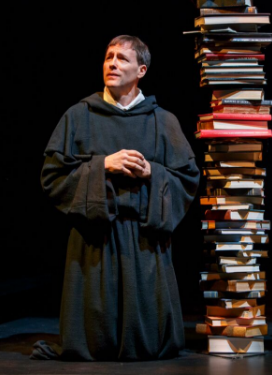
Last weekend my husband Whitney and I traveled to Manhattan with friends to see Martin Luther on Trial, the Fellowship for Performing Arts' most recent play,

We've been following founder Max McLean for a decade or so, since he came to perform his one-man Mark's Gospel for an event Whitney organized in his work at Scripture Union.

The words of the gospel jumped to life in McLean's performance, a rapid-fire journey through the life of Christ from baptism to resurrection.

After years of performing memorized scripture McLean began digging into other material. Several years ago, we invited friends we've known for decades to join us in Philly for The Screwtape Letters, a stylish, sardonic two-person show that captured the complex theology of C. S. Lewis and provided fuel for days of reflection and conversation.

Last year, the same six of us met in New York for The MostReluctant Convert, McLean's story of Lewis' journey into faith. We sat spell-bound in the Pearl Theater while McLean, pipe in hand, brought theology to life, capturing Lewis' brilliance, his disdain for sloppy thinking, his joy as faith broke through his lifelong inner solitude.

McLean's new play, also at the Pearl, ended its off-Broadway run Sunday. I confess, I was not as eager to go. Martin Luther is not one of my heroes, trial drama isn't my favorite, and I've been so busy lately the idea of a weekend away, even in Manhattan, seemed almost more chore than pleasure.

McLean's past plays have been one or two person shows. This one had six actors and for the first time, McLean wasn't one, serving instead as director. The play began with an imposing St. Peter sitting as judge in a trial demanded by an urbane, sardonic Satan.

According to Satan, Martin Luther was guilty of the unforgiveable sin and Satan was prepared to act as prosecutor. Luther's wife, Katie, was called, unprepared, to serve as defense attorney.

Two other actors rotated through the drama as a cast witnesses: Luther's contemporary Rabbi Josel, Hitler, Freud, Michael the Archangel, Martin Luther King, the Apostle Paul, Pope Francis.

Luther himself wandered on and off stage, writing, reading, talking, weeping, hammering his famous thesis to an invisible Wittenberg door.

We don't choose the times in which we live, but we choose how we respond. Luther lived in a time of great corruption, a time when religious leaders had compromised faithfulness to gather enormous financial and political power.

The play depicts Luther's determination to see past the fog of manipulation and corruption, his courage in calling power to account, his deepening depression and unmanageable anger when the church he loved ignored his call to repentance and renewal.

Through it all, his wife Katie defended him, challenged and confronted him, supported, fed and loved him.  Their unconventional love story was an unexpected bonus.

The trial itself spiraled to a grand conclusion, with Satan dropping his cool demeanor to shout accusations at Peter, Luther, Katie, Pope Francis, god himself.

After Satan's spectacular departure, Luther's final words, the same words scribbled on a scrap of paper just before he died, were repeated by others as they left the stage: we are beggars.

The unforgiveable sin was Satan's: demanding power, shouting accusation.

The final defense, for Luther, Peter, Katie, Pope Frances: we are beggars.

Walking back to our hotel through the lights of Times Square, watching beggars maneuver their wheelchairs along the crowded sidewalk, eyeing the sleeping shadows in the side-street alcoves, I found myself thinking of the timeliness of Luther's story.

What do faithful Christians do when Christianity itself seems aligned with power, wealth, manipulation and deceit?

How do we speak truth to power without falling prey to anger and despair?

The next morning our group met for breakfast across from Central Park, then walked down Fifth Avenue, past the machine-gunned-armed guards in front of Trump Tower, to the morning service at St. Thomas's Episcopal Church.

In his homily, (33-47), Canon Turner pulled two neighboring passages together in a way I'd not heard before, moving between the beatitudes in Matthew 5 to the third temptation of Christ in the chapter just before. 
Archbishop Rowan Williams once suggested that in order to understand the power of the Beatitudes . . . we have to look back to the narrative that precedes the Sermon on the Mount to chapter four of Matthew's gospel and the story of the temptation of Jesus in the wilderness. Williams suggest that it is the third and the most terrible of the temptations that is the most compelling as we try to understand the beatitudes.
The response of Jesus is the key to our understanding of the beatitudes.
On that mountain Jesus did not choose a relationship with human power and self-aggrandizement. Instead, he chose the perfect relationship he already had with his father and which relationship he would share with his friends.
The beatitudes are not a blueprint for church life. Neither are they a stoic way of dealing with disappointments. The beatitudes are the values of the kingdom and the making visible of that kingdom on earth.
As followers of Jesus we are called to make his kingdom visible through lives that are Christlike. We are blessed when we put God first and not the values of the world.
Blessed beggars. That's what we're called to be.

By any measure, I live a life of privilege.

Comfort, education, travel, opportunity.

No beggar sleeps in the Omni, attends off-Broadway play, wines and dines with friends.

And yet, on the deepest levels, I know my need.

Like Luther, I have wrestled with depression, anger, doubt.

I have struggled to make visible the values of the kingdom and failed. And know my failure.

Daily, I review the challenges around me and acknowledge how far I fall short of the task.

My patience falls short.

My compassion is lacking.

In every real way, by any honest measure, I am a beggar.

Dependent on grace.

Deeply in need of wisdom, insight, mercy and love far beyond my own.

I read back through the beatitudes, resting in the promise of blessing for all who know and admit their need.

We are blessed when poor in spirit, knowing our need of God.

Blessed as we mourn, saddened, as was Luther, by our own brokenness, and the brokenness of the world around us.

Blessed as we grow more gentle, restraining our own privilege to allow room for others to thrive.

Blessed as we hunger and thirst, pray and plead, for justice and shalom.

Blessed as we struggle to live with integrity, loyalties clear and undivided, centering our souls on God, shining as beacons of light to a broken, hopeless world.

Blessed as we work for peace, as we live in tune with God's redemptive love.

Blessed when condemned for speaking out against injustice.

Blessed when trolled and harassed for maintaining allegiance to God alone rather than the current endorsed idolatrous regime.

Rejoice and be glad at the invitation to live as beacons of another way.

Rejoice and be glad as we live - grounded in love- as a visible challenge to the lack of love around us. 

Like Luther, we live in a time of corruption.

A time of unraveling institutions.

A time of uncertainty, confusion, discord, disillusion.

As we work for justice, we will certainly fall short.

As we struggle to live as light, we will wrestle, daily, with darkness.

What a comfort, to say, with saints of every century: we are blessed beggars. This is true. 

Wir sind bettler.

Hoc est verum.

Sunday, March 17, 2013

"We Gorge on But and If and How"

Half Light and Silence,
C. Robin Janning, 2007
The tree of knowledge was the tree 
of reason.
That's why the taste of it
drove us from Eden. That fruit
was meant to be dried and milled 
to a fine powder
for use a pinch at a time, 
a condiment.
God had probably planned 
to tell us later
about this new pleasure.
We stuffed our mouths
full of it,
gorged on but and if and how 
and again
but, knowing no better.
It's toxic in large quantities; fumes
swirled in our heads and around us
to form a dense cloud that hardened 
to steel,
a wall between us and God, 
Who was Paradise.
Not that God is unreasonable – 
but reason
in such excess was tyranny
and locked us into its own limits, 
a polished cell
reflecting our own faces. God lives
on the other side of that mirror,
but through the slit where the barrier doesn't
quite touch ground, manages still
to squeeze in – as filtered light,
splinters of fire, a strain of music heard

then lost, then heard again. 
   (Contraband, Denise Levertov, 1992)

We are smart people, reasonable, educated.

Masters of pro and con, of assembled evidence, of closing arguments.

Our reason has yielded unexpected treasures: Penicillin. Telephones. Atom bombs. Agent Orange. 

If we can think it, it must be right.

If we can make it, it must be worth making.

As Denise Levertov said, “we gorge on but and if and how,” confident we know enough to tame the darkness, master weather, turn back the tides of time that carry us toward eternity.

We believe what we see. And as telescopes, microscopes, atom smashers, ultrasounds expand the bounds of the visible, we believe those things too. When it serves our purpose. When it fits our sovereign narrative.

Jesus said “Blessed are the pure in heart, for they shall see God.”

Of all the beatitudes, this may be the most difficult for modern Western men and women, schooled on  materialism, objective realism, "the tyranny of reason."

See God? Really?

“Pure,” to us, is a relative term. Nothing is pure. Not food, not water, not gold, not air. We have tests to identify and measure contaminants, lists of acceptable levels. Whole industries are constructed around processes to approximate purity, but never quite get there.

“Purity,” if applied to humans, conjures up images of parochial school nuns, talks about chastity. Paintings of virgin saints.

“Pure in heart”?

“Heart” itself suggests something old-fashioned, something to do with not-to-be-trusted emotion, feeling, belief. The heart itself is a muscular organ, pumping blood. Nothing more. Soul? Will? Character? The Greek word “kardia” points to the inner self. But what is that self? Who sees it? Does it have any reality beyond genetic codes or external forces that determine who we’ll be, what we’ll believe?

“Blessed are the pure in heart, for they shall see God.” 

Puzzling over this beatitude, I came across thoughts from Dietrich Bonhoeffer, German pastor and founding member of the Confessing Church that opposed Hitler, denounced genocide, and spoke out against the establishment church’s accommodation of the Nazi regime. In his Cost ofDiscipleship, he wrote:
“Who is pure in heart? Only those who have surrendered their hearts completely to Jesus that he may reign in them alone. Only those whose hearts are undefiled by their own evil--and by their own virtues too. The pure in heart have a child-like simplicity like Adam before the fall, innocent alike of good and evil: their hearts are not ruled by their conscience, but by the will of Jesus. . . The pure in heart . . . are not distracted by conflicting desires and intentions.” (112)
Our hearts – intentions, wills, however you want to translate that – are ruled by a muddy mix of motives and opinions. We insist on reason, claim we know best, but our vision is always skewed, our motives rarely “pure.”

As a teen encouraged to make a pro/con list regarding a major decision, I was troubled at how easily my reason could be managed. I could adjust the length of either list, find more reasons for, create reasons against. Sitting there staring at my half-hearted lists, I realized I could argue for anything, explain away anything.

What I wanted was something beyond my own brain. In prayer, I asked God to lead me and had my first glimpse of that light Levertov describes, that “strain of music heard, then lost, then heard again.”

Our divided hearts are on constant display. We want to be good people, live in comfort, go where we want the minute we want, eat whatever we think of any day of the year. Love our neighbors without spending time with them, or bothering to know their names. Breathe clean air without regulation, or thought of our own wasteful consumption. Know we’re right – on any issue – without thought, without work, without questions from those who dare to doubt us.

How often are we willing to say “I don’t know”? To admit “this question is beyond me”?

How often do we come, like children, and set our tangled messes at God’s feet, and ask his wisdom, help, and guidance?

One of my favorite Old Testament stories is of King Jehosophat of Judah. Threatened with attack from a vast, approaching army, he gathered his people to join him in prayer. As the enemy gathered, he affirmed God’s faithfulness in past times of crisis, explained the dire threat on its way, then concluded: “We don’t know what to do, but our eyes are on you.” (2 Chronicles 20).

As he and his people waited, God spoke through someone standing in the assembly, just a face in the crowd:  
“This is what the Lord says to you: ‘Do not be afraid or discouraged because of this vast army. For the battle is not yours, but God’s. Tomorrow march down against them. They will be climbing up by the Pass of Ziz, and you will find them at the end of the gorge in the Desert of Jeruel. You will not have to fight this battle. Take up your positions; stand firm and see the deliverance the Lord will give you.” 
The next morning, Jehoshophat and his people went out singing praise, head worshipers leading the way. Standing far above the field of battle, they watched the approaching armies turn on each other, and waited in awe for an unearned victory.

I've shared that story many times, in situations where my ministry team felt inadequate, in times when others looked to me for wisdom and I had none to offer. I've come to believe purity of heart is single-minded determination to do things God's way, even when that ways seems strange, unlikely, even dangerous.

Love neighbors – even scary ones. Trust God's provision, even when the cupboard is bare and money seems in short supply. Expect needed abilities to emerge – in others, and in me. In those places of childlike trust, I've seen God tear down that wall of disbelief; I've seen the light of his goodness shining through. I've heard his music, a refrain of joy I've come to know and love.  

1Lent2 Diane Walker, 2012
We live in a troubled time, only dimly aware of the challenges confronting the church, the country, the globe. We eat food that doesn't nourish us. Spend vast amounts of money on weapons that can't keep us safe. Our clean water is disappearing. Our weather is changing, in ways we can't reverse.

We argue details, list our enemies, gather our reasons. We assume we know the answers, when in fact the questions are so complex, so interwoven, so beyond our skill and knowledge that those most informed are forced to admit: “We don’t know what to do.”

In this Lenten season, I find myself fasting, praying, turning to the only one who understands the scope of our difficulty, the depth of our folly. I ask for purity of heart, a desire for God’s way, not my own, not anyone’s own, as I listen, study, think.

And I invite others to join me, helpless before the vastness of our challenges: “We don’t know what to do, but our eyes are on you.”


This is the sixth in a series on Lent and the Beatitudes:

Sunday, February 17, 2013

Seeking Blessing in a Fractured Land

Last week, at a Pennsylvania sustainable agriculture conference, I attended a seminar with the cheerful title “Understanding the Role of Environmental Agent Exposures in Health and Disease.”

Seated in a comfortable lecture hall in the Penn Stater conference center, I watched a series of slides reminiscent of a series I assembled for some presentations on food and farming I’ve led in the past year. The upward curves looked familiar: Increases in autism. Increases in obesity and diabetes. Increases in food allergies.


I was alarmed to see the series go on longer than my own: Parkinsons. Psyczophrenia. Leukemia.

Rick Woychik, the presenter, deputy director of the National Institute of Environmental Health Science, (a division of the National Institute of Health), quickly dismissed the idea that such explosive increases are the result of better diagnosis or some kind of genetic change. “We’ve controlled for the diagnosis theory. And genetic change takes generations, not decades.” His conclusion was the same as my own, although much more firmly stated: “The cause for these dramatic diseases is environmental.”

Woychik went on to explain the challenge of identifying specific causes, talked about the thousands of changes introduced to our environment and food supply in just the past few decades, reminded us that the human body, like the environment itself, is a system, with interdependent parts.

He described the old ways of testing environmental hazards: put some cells in a Petrie dish, introduce the substance to be tested, watch what happens. Or feeding some lab rats something new for a period of weeks, while everything else stays the same.

Not only are bodies far too complex for these simple tests to give adequate data, but how do you test the multiple ways that various agents interact with each other? New substances in packaging interact with new substances in food interact with pesticides and other toxins and with nanoparticles introduced at an alarming rate. Woychik talked quickly: BPA not just in plastic bottles, but lining aluminum cans, and coating cash register receipts. Substances crossing the placenta, interfering with brain development of infants in their mothers’ wombs, with results that might not appear until the onset of Parkinson’s or osteoarthritis or other diseases, decades later.

When he finished and asked for questions, there were several seconds of stunned silence. One listener said quietly: “I feel informed, but not empowered.” A young woman raised her hand and asked, “If you had a daughter who was pregnant, in her first trimester, what would you tell her?”

In some countries, the Precautionary Principle holds sway. It was stated as part of the Rio Conference, or "Earth Summit" in 1992: 
"In order to protect the environment, the precautionary approach shall be widely applied by States according to their capabilities. Where there are threats of serious or irreversible damage, lack of full scientific certainty shall not be used as a reason for postponing cost-effective measures to prevent environmental degradation."
Another formulation, from the 1998 Wingspread Conference on the Precautionary Principle, is a bit more direct: 
"When an activity raises threats of harm to human health or the environment, precautionary measures should be taken even if some cause and effect relationships are not fully established scientifically."
In some countries the Precautionary Priniciple governs food regulation, agricultural practice, mining and drilling, introduction of synthetic products or genetically modified crops.

In the US, the assumption has been, if it’s good for business, it’s good for the rest of us. Which has brought us chemically and radioactively mutated wheat, feed grains laced with pesticide, growth hormones in our children’s milk, high fructose corn syrup in foods that once were completely healthy.

Keystone XL Tar Sands Climate Threat
And carbon-laden, dirty, environmentally destructive tar sands oil, prompting the largest environmental protest in US history – today! – asking for President Obama to reject, completely, the Keystone XL pipeline and any other pipeline expansion that would further the mining of tar sands oil     

I've been carrying with me the words of Jesus in from the Beatitudes (Matthew 53-10): “Blessed are the poor in spirit.” “Blessed are those who mourn.” “Blessed are those who hunger and thirst for righteousness.”

They’re puzzling words, partly because we see “blessed” as synonym for “happy”. We have no word that comes close to the complexity of the original word, “makarios,” which seems to imply being rightly placed, set in right relationship with earth, other humans, and God as well. There’s a hint in “makarios” of participation in eternity, of deep harmony, of that inner well-being that sometimes washes through us when we know we’re loved, living wisely in ways that benefit those we care for. 

The best explanation I can find is from Spiros Zodhiates, Greek-American Bible scholar:
To be makarios, blessed, is equivalent to having God's kingdom within one's heart. Aristotle contrasts makarios to endees, the needy one. Makarios is the one who is in the world yet independent of the world, [whose] satisfaction comes from God and not from favorable circumstances.   (Complete Word Study Dictionary)
The beatitudes make no sense once we've bought the version of “happy” sold in every thirty-second ad: convenient, easy, enviable, cheap. Whiter teeth, the newest phone, more food, and more, and more.

Puzzling over the beatitudes, and what they have to say to the issues of the day, I came across this extended quote by Brian Zahnd, a mid-western pastor and author of a new book called “Beauty Will Save the World”: 
"The Beatitudes pose a direct challenge to the way the world is run. The Beatitudes are a subversive manifesto at odds with superpower agendas. As a result, the Beatitudes (when liberated from sentimental patronizing) elicit differing responses depending on who the hearer is. There are those who are blessed by the Beatitudes and hear them as a clarion call for welcome change. Others feel threatened by the radical revolution the Beatitudes appear to embody. . . 
The Beatitudes are the antithetical ethos to the superpower mantra of “we’re number one!” The Beatitudes are deliberately designed to shock us. If we’re not shocked by the Beatitudes, it’s only because we have tamed them with a patronizing sentimentality—and being sentimental about Jesus is the religious way of ignoring Jesus! Too often the Beatitudes are set aside into the category of “nice things that Jesus said that I don’t really understand.” 
"We have not been formed by the values of the Beatitudes; we have been raised on the received text of a superpower. (The notion that the received text of a superpower and the sacred text of the Sermon on the Mount can be made to fit together nicely is lunacy!) Contemporary Americans are scripted in a way that is completely counter to the values of the Beatitudes. We certainly don’t bless poverty or sorrow or meekness or hunger or persecution—yet it is the poor and sorrowful and meek and hungry and persecuted that we find Jesus blessing in the Beatitudes. At the very least, this should perplex us." 
I don’t have Zahnd’s book – so can’t read his conclusions. But I hold tightly to the perplexity he describes, and welcome the clarion call for change he hears in Jesus' words. Running down our current road will never bring blessing – just more and more suffering, poverty, disease.

Blessing lies in another direction. Blessing comes when we set easy answers aside, force ourselves to understand the depth of our mistaken desires, begin the painful process of divesting, rethinking, moving in a new direction. Blessing comes when we seek the vision of wholeness, and holiness, embedded in Jesus' teachings.
What does that look like, for me, today?

I’ve given up wheat and high fructose corn syrup for Lent. I’m sure that sounds ridiculous, insignificant, wildly unhelpful, not even marginally spiritual. But the more I learn about our current food systems, the more convinced I am they need to change, and wheat and corn syrup have become, for me, signs of harm done, and symbols of our folly. They’re implicated in far too many maladies to name, present in most of our processed foods, and giving them up forces me to look for real nourishment, and to grieve my own addiction to sweet, cheap, convenient food.

I’m also spending time, a few minutes a day, advocating for change I believe in. Today, that means posting comments on Whitehouse.gov asking President Obama to reject the Keystone XL pipeline. And posting some links to organizations working on climate change and our excessive dependence on fossil fuel.
And praying. Always praying.

For wisdom.

Real health.

Insight.

Change.          
When people forget that Jesus is the bread of the world, they start eating junk food--the food of the Pharisees and of Herod, the bread of moralism and of power. To often the church forgets the true bread and is tempted by junk food. Our faith is not just about spiritual matters; it is about the transformation of the world. The closer we stay to Jesus, the more we will bring a new economy of abundance to the world.  (Walter Brueggeman, The Liturgy of Abundance, The Myth of Scarcity)   Amen.

This is the second in a series that will continue through Lent (February 13 to March 31). 
1. An  Alternative Narrative: February 10