Showing posts with label life. Show all posts

Sunday, January 27, 2013

Choosing Life

What matters?

It’s been a very cold week in our part of Pennsylvania.

And in many ways a sad week.

I started the week off in an encouraging meeting with people deeply interested in food and farming. I was planning to write this week’s post about “loving the real world”: real food, real places, the real beauty and goodness of the world we've been given.

Then came the celebration of President Obama's inauguration, the genuine joy of so many who had felt shut out of the mainstream of American life. I listened to the hopeful reflections of aging freedom riders, interviewed in front of  the King memorial, so happy to have an African American president return for a second term. For them, the inauguration underscored the hard work of Martin Luther King and so many who walked beside him, and marked how far we've come, how far we have to go.

I’m not much into style, but it was fun to hear the raves about Michelle Obama and her lovely daughters, to celebrate a smart, strong, beautiful first lady whose confident poise gives hope to women unsure about their own opportunity or value.

Then the week took a sadder turn.

Reminders of unwanted babies: more than 54 million in the last forty years.

A statement by Rush Limbaugh, circulated with glee on one side, outrage on another:  “You know how to stop abortion? Require that each one occur with a gun.”

Thirty-seven hostages killed in Algeria.

Another school shooting, sad reminder of the deaths in Newtown.

The senseless murder of a promising young doctor, strangled then burned in her own suburban home. 

Endless discussion about guns: why we need them, who should have them. As if guns will be the solution. As if guns will somehow keep us safe.

What does it mean to choose life?

Twenty years ago I marched in the pro-life marches in DC, sometimes with my own small kids in tow.


In the years since then, I've spent time with many women who've wrestled with poverty, abusive relationships, a powerlessness so deep any choice seems beyond them.

And I've spent time with many who claim to be pro-life, yet speak with contempt of  poor, unmarried mothers, of women who've given birth to children in hard circumstances and struggle to raise those children with little help from any direction.

What does it mean to choose life in a culture where guns are easier to get than safe, affordable contraceptives?

In a culture where violence seems a reasonable solution, where appeal to guns is part of political discussion?

What does it mean to choose life in a culture where children, teens, adult men and women, find fun in games where the point of the game is death? Call of Duty, Grand Theft Auto, Halo, Medal of Honor, Mortal Kombat, the list goes on – a 17  billion dollar industry in 2011, with many millions of Americans spending vast amounts of time wiping out opponents, blowing up anything in the way, moving toward ever more violent objectives.

What does it mean to choose life, cherish life, nurture life, celebrate life?

On a cold January day, I sit watching the birds at my feeders. I’m cheered today by a hermit thrush, flicking its rusty tail, hunting seeds in the stubble of my garden.

Pine siskins press in close at my finch feeder. A nuthatch savors suet near my window. White-throated sparrows scratch for seed in the frozen ground.

We are smart people – with power scarcely imagined by men and women just a century ago.

We can talk to friends on the other side of the world, see their faces as we talk.

We can rearrange genes: we can make pigs so fat they can’t walk. Wheat that kills any insect that tries to eat it.

We can terminate life in more ways than we can count: pills, injections, electric chairs, unmanned air craft, heat seeking missiles, viruses, bombs, drones. any kind of gun.

We can make imaginary deaths look so real the audience turns away in horror.

We can make real deaths so casual no one even cares.

I believe life matters. And I grieve.

I grieve the 54 million babies - tiny lives unwanted. Inconvenient. Terminated.

I grieve the millions who die each year from dirty water and preventable disease.

The millions who die from lack of food.

The deaths from war, from illicit trade in drugs, weapons, humans. 

The lives spent in fear: women in their homes, families in their border towns. Lives spent watching for the raised hand, the reckless gun, the hidden bomb, the sudden flash of light.

And yes, I grieve the billions of hours wasted imagining death. Celebrating death. Practicing death.

The billions and billions spent supporting death in all its forms.

What would it mean to choose life?

What would it mean to insist that imagining death is not entertaining? Not acceptable? Not part of a culture of life?


What would it mean to support women in hard choices, to make children a joy instead of a burden, to value people more than profit, to rethink the bottom line?

What would it mean to imagine a world where every child has a safe home, clean water, healthy food, adequate schools, the hope of productive work somewhere out ahead?

Some days that seems almost possible.

Some days, the best I can do is feed the birds, hug those near me who need a hug, and pray.

Some days, even prayer seems out of reach.


This is the fourth of a series for the new year: "What Matters"
Please join the conversation. Your thoughts and experiences in this are welcome.
Look for the "__ comments" link below to leave your comments
. 

Sunday, October 28, 2012

Love Your Neighbor, Vote with Prayer

Ten days left until the 2012 election. My phone is busy with robocalls imploring me to save America, and my mailbox blooms with glossy colored postcards urging me to stand against a mix of urgent threats.

For some of us, voting is easy: walk into the polling booth and vote the party ticket. For others, though, that seems immoral: a sell-out to party power, an encouragement to our politicians to represent the agendas of deep-pocket party supporters rather than the needs of simple citizens.

A few weeks ago, registering voters in our local library, I found myself in conversation with a recently naturalized citizen, a man eager to participate in American democracy.

“How will I know who to vote for?” he asked earnestly.

“You can find a sample ballot at this website,” I said, scribbling a web address on the handout we’d given him: SmartVoter.org, offered by the Pennsylvania League of Women Voters. It provides information about polling places and hours and sample ballots for every precinct.  (In other states, the same information is available on Vote411, provided by the US League of Women Voters). 

“But,” he seemed uncertain how to say it, “how will I know . . .” He paused, unsure.

“What they stand for? What their positions are?”

“Yes.”

“That’s harder. But this is still a place to start." I explained that SmartVoter (and Vote411) provide links to candidates' websites, plus pass on answers some candidates have given to specific League questions. 

I admired the man’s motivation. Still learning the language, still struggling to find his way in a confusing new country, he was determined to understand the issues and to use his vote wisely.

I set out several months ago to think through issues and to argue that “voting as a Christian” doesn’t mean giving my vote without thought to the party that claims to stand for “Christian values.” In a recent article, The Politics of Abortion: Should Christians Vote Straight Ticket, Elliot Miller of the Christian Research Council argues that in their zeal to oppose abortion, Christians have become pawns of a party that claims to uphold a pro-life movement while often pursuing conflicting goals: “ Straight-ticket voting allows your party to get away with paying mere lip service to your issues.”

I find myself wondering: how many of us are aware that of the seven Supreme Court judges who ruled in favor of abortion in the landmark Roe v. Wade case, five were Republican? Of those who dissented, one was Republican, one Democrat. The history of political party and issues of life is far more complex, and in many ways more cynical, than most of us understand. 

Miller argues, as I did in my post "The Least of These":
“A pro-life ethic should not only apply to the unborn but also to the born, including people whose lives would be lost in a frivolous war, the catastrophic loss of life that could occur from a policy that results in nuclear war, loss of life due to environmental degradation (not just apocalyptic global warming scenarios but present-day famines in Africa and elsewhere that we have the means to do something about), the lives that are being lost daily in America through the ready availability of assault weapons, and so forth. If a candidate claims to be pro-life but promotes reckless policies on some or all of these issues, that needs to be factored in.” 
As Miller notes, pro-life Democrats have found their  more holistic pro-life efforts“sabotaged by the pro-life movement.” This is currently the case in Pennsylvania, where a moderate pro-life Catholic Democrat, Bob Casey, has been ranked “0 percent faith-friendly”  by a blatantly dishonest "Voter Guide for Christians." 

A closer look at Casey’s positions shows  a consistent pro-life stance that still insists on accessible contraception and womens’ health care screenings, whether through Planned Parenthood, health insurance mandates, or other health care provision. He has been unfairly labeled “pro-abortion” because he insists, I think correctly, that the fastest way to reduce abortions is to make sure women have affordable family planning information and support, while the current “pro-life” movement seems determined to cut funding for anything that might help women limit family size wisely. I admire Casey’s respect for women and for life, and his courage in trying to vote his conscience, even as the pro-life movement joins the party faithful in aggressive and deceptive attempts to unseat him.  He is one of very few pro-life Democratic senators left, and unapologetic about his Christian faith, passion for justice, and motivation to serve the poor. Wouldn’t it make sense to encourage and support him? Apparently not.

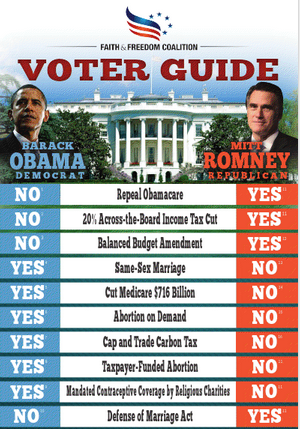
The Faith and Freedom scorecard disseminated widely in churches and religious sites offers ten essential topics for a Christian to consider when voting, including "Repeal Obamacare," "20% Across-the-Board Income Tax Cut," "Cap and Trade Carbon Tax."

I've been reading the Bible all my life. Please: in what way is a 20% across-the-board-tax cut a “Christian value”? 

And how is repealing "Obamacare" one of the top ten priorities for someone concerned with seeing faith play a role in our political decisions? From what I can tell of God’s concern for our health, I’d say Good Samaritans among us should think carefully before deciding that those with pre-existing conditions or low-paying jobs don't really need insurance. 

Cap and trade? Am I expected to believe that Christians should – as a matter of faith and freedom - vote AGAINST protecting the environment fromincreasing carbon emissions and worsening climate change? (Ever hear of Kiribati?)

I’ve mapped out some of the issues I’ll be considering as I prepare to vote:
While we many argue about the wisest, most faithful approach on any of these issues, I am more convinced than when I started that the Christian faith has much to say about matters too often ignored by those who claim to speak for the church.While some would like the government to legislate on moral issues and stay out of the way on matters of economy and regulation, others believe that the role of government is to maintain justice and protect the common good, while leaving matters of personal morality to the guidance of the church. In every arena, solutions that seem obvious to one person may appear implausible, wrong-headed, or genuinely evil, to another. 

Which is why, as I suggested when I set out on this series back in July, we are responsible to examine issues, think through the proper role of government, and advocate and vote in ways that reflect our own convictions. For those of us who claim to follow Christ, the need is greater than ever to demonstrate our commitment to the priorities Christ taught us, priorities of mercy, compassion, peace, justice, rather than the agendas promoted by party politics, wealthy donors, and slick political ads.

When we let the maneuverings of political "faith leader" groups shape our votes and our voice, both our witness for Christ and our influence for good are hijacked.

To find out individual candidate's stances on issues that matter, Smartvoter, or, in other states, Vote411, offer answers to specific questions, and links to candidate websites. For those who hold or have held public office,  On the Issues offers specifics on votes cast for and against legislation, as well as quotes from candidates on a wide variety of issues. The public record of candidates sometimes paints a much more nuanced picture than opponents might give; it also can show inconsistencies, and obvious attempts at manipulation of voters. 

The Voter Guide, a national site, offers links to local voters' guides, some with more information than contained in the League sites. OpenSecrets provides information about campaign finances, contributors, lobby groups. Another website I'll be consulting is the Grover Norquist "Taxpayer Protection PledgeSigner" site. I object strongly to anyone taking a pledge that prohibits wise consideration of all solutions. It’s highly doubtful I’ll be voting for anyone on Norquist’s extensive list. 

We live in a broken world, with broken institutions, broken people. There are no perfect candidates, no perfect platforms. Those who cry for peace will have to look elsewhere. Those who long for justice will find that agenda sadly missing. Those who pray for wiser use of natural resource will search, maybe in vain, for candidates standing firm on clean air, clean water, clean food.

But I’ll still vote. I think of the hundreds who died in Tiananmen Square, hungry for the rights we take for granted. I think of the women in Liberia, facing down men who used violence of every kind to maintain control and silence opposition, or the dissident writers spending decades in prison, gulags, camps, composing poems in their minds, writing speeches in their memories, waiting behind bars for the simple right to speak. I listen to reports of young activists in Syria, battered for their dream of freedom, and promise to invest more deeply in the freedom I've been given.

Our votes are not about defending our own rights, our own parties, our own strongly-held opinions. They’re tools in the service of the common good, one more way to defend the rights of the poor and needy, and to love our neighbor as ourselves, even when that neighbor speaks a different language, or prays for peace in a country other than our own. 


Speak up for those who cannot speak for themselves,
    for the rights of all who are destitute.
Speak up and judge fairly;
    defend the rights of the poor and needy.
    (Proverbs 31:8-9)


Learn to do right; seek justice.
   Defend the oppressed.
Take up the cause of the fatherless;
   Plead the case of the widow.
   (Isaiah 18:17)


This is part of a continuing series about faith and politics: What's Your Platform? Join the conversation.  Look for the "__ comments" link below to leave your comments.  


For further thoughts on values and faith, I recommend the work Miroslav Volf has done this fall in thinking through Values of a Public Faith: Values of a Public Faith (part one), Values of a Public Faith (part two), Values of a  Public Faith (part three). Sojourners has also produced a downloadable pdf,  "Why Voting Matters: An Issues Guide for Christians." And Evangelicals for Social Action provide a similar guide: "Can My Vote Be Biblical."  Note: none of these resources say "This is who you should vote for." Instead, they raise important questions, offer suggested guidelines, and argue for informed individual decisions.